Showing posts with label Techniques. Show all posts

Tuesday, November 25, 2008

Hidden Color in Muted Seasons


Color is where you find it - or where you create it. Even in the more muted seasons on the shoulder of fall/winter or winter/spring it can be found in some pretty unexpected places and the results can be much more than you would expect at first blush.

The two images shown here, "Birch Tangle" and "Dogwood Dance" barely show the trees t
hemselves and focus instead on the tangle of branches and the few remaining leaves. The blue of the sky and the soft focus whites of other birches in the background give this image the effect of a painting whose power is derived not from the subject but from the interplay of color and form within the final composition. 

While both are "straight" photographs, with no manipulation at all, each, nevertheless, has a feel of something more than a photo to it. 


Sunday, November 16, 2008

The Conversation


This image was photographed at the Sandwich Fair in Sandwich NH. Originally shot in color I first converted the image to black and white because I felt that the simple subject was most important and that color in the image added no value. 

After making the conversion, it was clear that I also needed to de-emphasize everything in the image except the two farmers and the ox. In this way it appears that there is a conversation taking place between the three.


Tuesday, November 11, 2008

Combining Images to Tell a Story


They (whoever "they" are!) say a picture is worth a thousand words and this is true. But two images combined together may just create a whole that is greater than the sum of its parts and form one image that is worth ten thousand words.

It may also simply tell the story you intend to tell more effectively or simply capture the imagination of the viewer in a more powerful way.
The picture at the right begins to tell a story, but the people standing in the background . . . well they don't really capture the human side of the story very well.

I was in the city of Calibar, Nigeria with Kip Bates and in our exploration we came upon a beautiful grove of rubber trees through which stretched a dirt path traveled by children fetching water for their families in the village nearby.

I was intrigued by the rubber tree taps and the colorful nature of the tree where it is slashed to allow the sap to drip into the bucket. I was equally intrigued by the sight of the children walking through the grove on their way home. I took quite a few images of both but found myself unsatisfied with all of them as "stand alone" images that told a story.


So I set about to create a Mindscape tellling a story using a combination of images. Mindscape is my term for a manipulated image that captures a story or takes a step beyond the simple image.

The first step was to isolate the tapped rubber tree and to emphasize the colors of the tree where it had been slashed. This was done by first using the Extract function of Photoshop to remove the unwanted people from the image. Having done that, I then used the saturation filter to bring out the color a bit more, without changing it. The resulting image you see below.


Then, I chose about 6 different images to experiment with as my base image. Dropping the tapped tree over them and making a judgement about whether they worked aesthetically first and secondarily if they told a story in a more powerful way. In other words: was the "whole" (the combined image) greater than the sum of the parts?

With three of the images, my answer was almost immediately "No". Not because the combined images didn't work at all, but because the final result did not hold the promise of the other three images.

Once I had picked the three to use, I then worked on each image to improve the blending of the two images. This involved using the cloning tool, the paint tool and in the case of the final image below, I went so far as to mute the background using both gaussian blur and desaturation followed by full restoration of the colors central to the image but only partial restoration of the background colors.

The results can be seen below:

Rubber Tree Mindscape


Walking Through Rubber Trees

Children of the Rubber Forest


Monday, November 10, 2008

Timing is Everything in Photography


On a recent visit to the New England Aquarium in Boston there was an exhibit on Jellyfish. I was intrigued by the beauty of these sea creatures and could have taken hundreds of images of nothing more than the forms created by their undulating movement but as I stood there I realized that there might be an interesting image presented if I waited patiently as adults and children passed by on the other side of the tank from me. I was right. After about 15 minutes a young child came up to the tank and reached up with both hands toward the jellyfish.

The hands of the child we already distorted somewhat by the water and tank between us, I emphasized the distortion a bit more, keeping the jellyfish image itself sharp and clear.


Saturday, November 8, 2008

Light + Imagination = A Better Image


The difference between a snapshot and a photographic image in which you can take artistic pride often lies - not in front of you, but between your ears.

Look around; think through your image; and then, think ahead to whatever creative process you employ after the shooting is over. There are often dozens of directions for you to go that take your image from mundane to magnificent.

Today we'll take a look at using the flowers in this bud vase to create several unique images.

For some the mere sight of God's creation to the right is sufficiently beautiful that nothing more need be said. If that's the case for you, and you are satisfied with something like the snapshot at right - more power to you. You need not read on. 

However, don't expect to walk into a gallery with a framed image like this and be greeted as the next coming of Edward Weston. 

Now, don't get me wrong. There is, of course, a place for images like this. A shop that leans more to the crafts rather than the arts, may be very happy to take this image on consignment. The colors might be exactly right for a piece that a decorator is looking for to add a splash of color to the wall in that ski condo he's been hired to decorate. Pieces like these are quite marketable but they should not be seen - or priced - as art.

Art is created when you take the image to the next level. So lets look at a few ways that this bud vase of flowers can be used to create a piece that the gallery might say yes to.

On the day that I took the photo above, I was visiting a friends apartment. Light was streaming through the window of the kitchen onto the floor and the table at which I sat was shaded by the wall. With permission, I began by moving the table into the light and taking advantage of the arc of the chair's back to add an additional form element to the image.

The first creative image thus combines several new elements to make the flowers important but not singularly important. Instead we employ color, light and form within the context of the image.


After photographing the flower still in the bud vase, I then, with permission, removed the flower heads and placed them on the table - first with nothing else and then later with a glass of wine I had been sipping on. I photographed them in a number of ways but the two images below are my preferred images among many. 


Fowerheads and Wine Glass


These images, in my opinion, do not cry out for further embellishment and, in fact, I offer all three for sale in select galleries. However, I did play around with them a bit to create two different Mindscape images that you will see below. The second being nothing less than an accident that I found to be interesting nonetheless. 


Flowerhead Mindscape 1


Floating Flowerhead Mindscape

Mindscapes Gallery

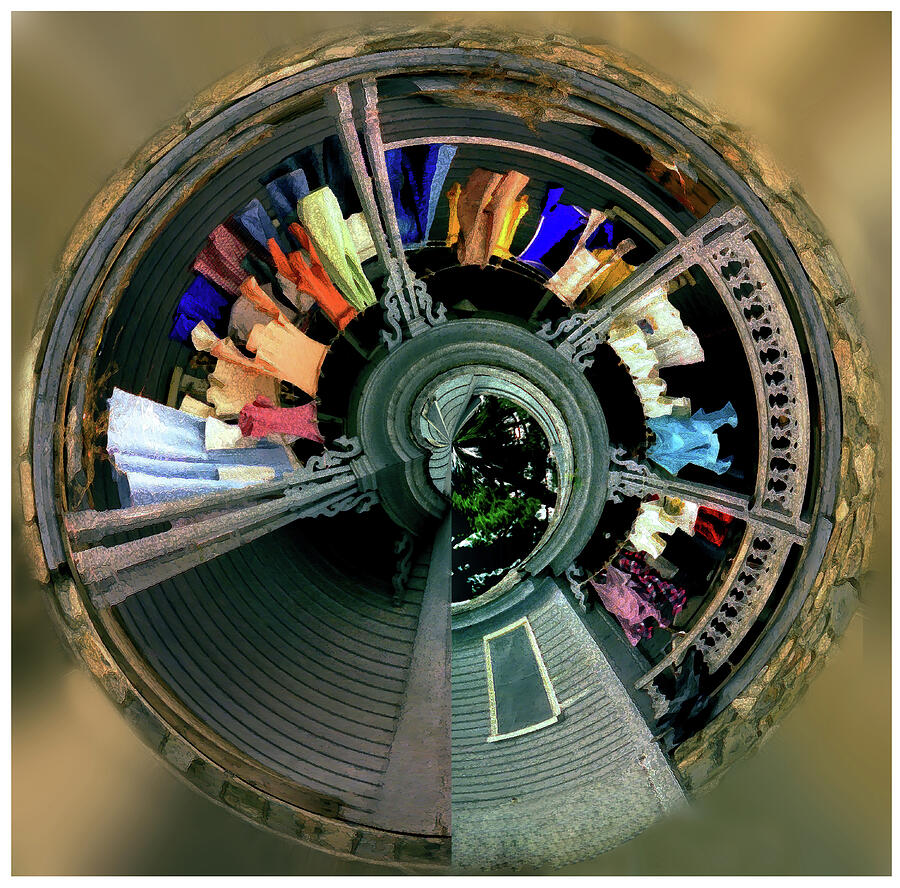
  Circular Washline Squared For a signed original of this image, click here Large work: 29.5 x 30" $495 Small work: 9.5"x10" ...